
The typical dream has always been the same. We dream of big houses with wide open rooms, a garden where kids can run free in the summer, a two-car garage. This is ingrained in us from childhood.
Think back to the dollhouses and miniature worlds of our youth. They were scaled-down mansions. They had multiple stories, grand staircases, rooms for every imaginable purpose (a ballroom! a library!) and tiny, ornate furniture that had almost endless capacity for things.
The message was clear: to have a big life, you needed an even bigger container to hold it.
But somewhere along the way, people started questioning if size really equaled fulfillment. Was a bigger house truly the measure of a bigger life, or could the opposite be true? What if a smaller space could open the door to more freedom, more experiences, more connection?
That’s where the tiny house lifestyle steps in: a way of life that challenges the old dream, proving that less can actually give you so much more.
How much space do you really need to live comfortably? Is tiny home living worth it?
A Shift in Perspective
There comes a point in life when material things don’t quite carry the same weight they once did. The thrill of wanting more starts to lose its shine. You wake up one day and realise you’re no longer dreaming of the sports car or the millions in the bank. Whatever society has told us is the benchmark of a successful life.
Recent design conversations echo this shift. The BBC explored how modern minimalism is evolving into something softer, what some call relaxed minimalism.
And it turns out this shift isn’t just about looks. Research by Lloyd et al. found that minimalism can boost mental wellbeing by helping people feel more in control, less stressed and more mindful in their daily lives. In other words, living with less can actually make us feel lighter.
Architect Sarah Susanka, known for The Not So Big House, also challenges the notion that more square footage equals better living. She advocates for ‘right-sizing’. Homes should be designed around comfort, proportion and meaning rather than sheer size.
This perspective lies at the heart of tiny living. When every corner, material and detail is intentional, a home, no matter how small, feels deeply personal and expansive in spirit. What you lose in space, you gain in presence. What you give up in excess, you reclaim in ease.
Writer Kyle Chayka, in The Longing for Less, beautifully captures this evolution. What we love about his work is it doesn’t treat minimalism as another aesthetic to aspire to. It’s not a perfectly curated room or an Instagrammable lifestyle influencers could sell. He traces its roots in art, philosophy and lived experiences to show how it has always been about something much deeper.
Chayka explores how, in an age of overstimulation and relentless consumption, many of us have begun to crave emptiness not as absence, but as presence. To strip away distractions is, in essence, to make room for what truly matters.
Through this lens, small space living is about living with enough, not less. Enough space to think, enough stillness to notice. When you pare your world down to what feels essential, you begin to live more deeply within it.
The Secret Ingredient… Smart Design
Of course, embracing ‘less’ in theory is one thing. Living it comfortably is another. The secret to making small spaces feel big and deeply livable comes down to smart design.
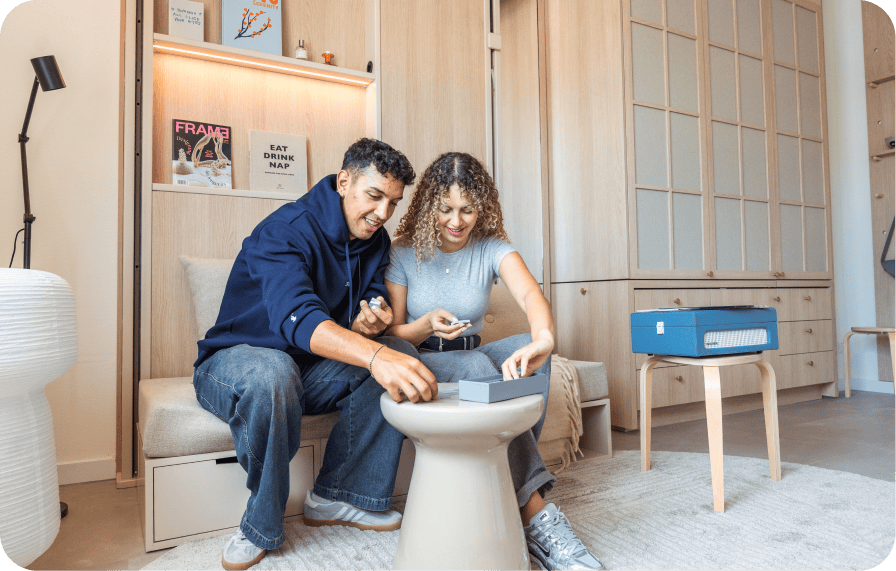
One of the best examples of this is The Citylifer’s Nomad Studio. It is a compact, contemporary living concept that shows how smart design can redefine what small-space living looks and feels like. Take a closer look at its features:
High Five Bed
Unlike a traditional bed that occupies the same footprint day and night, the High-Five Bed literally rises above it. The entire bed ascends into the ceiling and frees up valuable floor space.
When it’s tucked away, your space becomes whatever you need it to be. With a quick rearrangement, it turns into a walk-in closet where you can dress, organise or pack for the day. Slide out a table and it becomes a bright, focused workspace. Or clear the floor entirely and you’ve got an open area for movement.
But beyond its clever mechanics, what the bed truly represents is a mindset. It represents tiny living. With an innovation like this, people get the chance to create more room for life to unfold.

Genkan Entryway
In Japan, before crossing the threshold, guests remove their shoes in a small area known as the Genkan (玄関). It’s the point where the outside world is left behind before entering the calm of the home.
The Genkan entryway is reimagined for The Nomad. Each unit includes a small, personal entry nook but with one important twist. Instead of being inside the apartment, the Genkan extends outward into the shared hallway.
This, in turn, transforms the experience of apartment living. Hallways, which are often sterile and silent, become active social zones. It invites residents to make this shared space their own — to leave a plant, hang an artwork, display something that reflects their personality.

Pivot Wardrobe
The Pivot Wardrobe is a clever space-saver that hides a full-sized table within its frame. You can pull the table out for your morning coffee, slide in your laptop for work or set it for dinner with a friend. When you’re done, the table folds neatly back into the unit, restoring the calm and openness of your space.
When you start to live with features like this, you realise how powerful small-space design can be. Every detail has a purpose. When everything is this intentional, a space doesn’t have to be big to do big things.

The Psychology of Spaciousness
We think of space as something purely physical. A figure that dictates how much we can own or how comfortably we can move. But in truth, spaciousness begins long before we measure walls or draw boundaries. It begins in the mind.
Our sense of openness has as much to do with how we inhabit space as with how much of it we have. Two people can live in the same-sized room and experience it entirely differently.
Mental Clarity Begins with Physical Clarity
This difference often comes down to mental spaciousness. Environmental psychology has long shown that clutter, overstimulation or poor zoning can quietly tax our brains. When our eyes and minds are constantly busy, rest becomes harder to find.
This is especially true in a compact home where there’s no physical separation between work, rest and leisure.
The opposite is also true. A well-designed small space can create a surprising sense of ease. It reduces what psychologists call cognitive load, the mental effort it takes to process visual information.
Lighting, natural views (green spaces), order in layout — these all help an environment feel larger, more breathable, more restorative. Even if the square footage is small, a well-organised, well-lit, uncluttered space can feel spacious.
Design That Expands Without Adding
You’ve probably been influenced by the American dream, even if you don’t realise it. For years we’ve been told that success means more. The bigger the house, the better the life.
Real spaciousness, however, isn’t about adding. Designers who work with limited footprints often focus on perception rather than scale. Natural light is their greatest tool. It softens corners and makes boundaries feel less defined. When daylight flows freely through a space, the mind perceives openness, even in a small room.
Thoughtful zoning also matters. You have to give every area a clear purpose. A rug under a dining table or a pendant light above a workspace tells the brain: ‘this belongs here.’
Gestalt Psychology and the Need for Visual Harmony
But why does our brain crave order? Gestalt psychology offers an interesting lens here. Our brains are wired to find order in what we see. We naturally group shapes, colours and objects into patterns that make sense.
This explains why certain interiors feel instantly harmonious while others seem overwhelming. Even when they contain the same number of things.
When a home follows basic Gestalt principles — like symmetry, proximity, repetition and continuity — it just feels easier to look at. Your eyes can glide smoothly through the space without getting caught on clutter or confusion.
Objects that are placed close together feel naturally connected. Repeating colours or materials creates a sense of rhythm. Clean, continuous lines gently guide your gaze.
All of this reduces cognitive effort. The less mental energy it takes to make sense of a space, the calmer and more spacious it feels.
Bringing Nature Indoors
Being in nature helps us breathe a little deeper. The scent of rain on soil, the sound of waves crashing on the shore remind the body to slow down. In National Geographic’s Call to the Wild piece, people perform 50% better in creative problem-solving tasks after a few days unplugged and immersed in the natural world.
You don’t need to live on a forested hillside to tap into these benefits. A few houseplants, wooden textures or a window that lets in fresh air and daylight can ease tension and steady the nervous system.
Designers sometimes talk about visual rest: the feeling of calm that comes when your eyes land on something organic, unforced, alive. That’s what nature brings to a room. It slows us down. It balances the geometry of man-made design with the fluid, forgiving shapes of the natural world.
How Tiny Living Enables Movement and Growth
There’s a strange paradox in living small: the less space you take up, the more room you actually have. They are invitations to rethink what truly matters. Every square metre you don’t fill with possessions becomes a square metre available for living.
Living Small Means Living More
Fewer possessions mean less to clean, organise or worry about. Fewer things tying you down create a sense of freedom you can feel the moment you walk through the door.
You find it easier to say yes. A friend asks if you want to stay with her in London for a year? Why not. Your mother needs you to help out after her surgery? Sure. You want to visit a new country on a whim? Absolutely. There’s less baggage to carry. Literally and figuratively.
Intentional living spaces make choices simpler. Without the weight of excess stuff, every opportunity feels more possible. The space you inhabit becomes less of a container and more of a springboard.
Tiny Together
It’s easy to assume that living small means living lonely. That a tiny apartment equates to isolation, that fewer square metres limit your life. But the truth is the opposite.
When integrated into well-designed coliving environments, tiny homes thrive on community infrastructure. This includes shared lounges, coworking spaces, rooftop gardens and communal kitchens that allow residents to step out of their private units and into connection.
The Layering of Privacy and Presence
One of the secrets of successful coliving is smart layering. Private spaces don’t have to equate to isolation. Even the tiniest units can feel big when residents have access to shared zones. In these buildings, you can retreat to your apartment for solitude, yet step just a few metres away into a space for community events.
You’re never cramped by square footage alone, because your environment offers modes of interaction.
This is one of the core philosophies behind coliving. Each person has enough space to live comfortably on their own, but the building as a whole functions like a living organism. Shared areas act as the ‘social lungs’ of the community. Rooftop gardens invite conversation over fresh air and greenery. Lounges become hubs for connection. Coworking areas let ideas flow between neighbors.
When tiny living is done this way, you gain more in human experience.
Zooming Out to Zoom In on What Truly Matters
Tiny living is often misunderstood. People think it’s a limitation. But when a space is small, when you have something limited to work with, it demands intentionality. And in that intention lies freedom.
In a tiny home, you can’t just grab something off the shelf because it’s trendy. Or click ‘Add to cart’ on a big couch that looks good on Instagram. There’s no room for impulse. Every piece you bring in has to earn its place.
That means more thought goes into every decision: the chairs you sit on, the kitchen tools you actually use, the clothes you wear.
You quickly start noticing patterns in your own life. Do you really need three different coffee machines, or is one good one enough? Would a sprawling sofa be wasted if you spend most evenings curled up with a book, or would a compact loveseat serve your needs perfectly?
Tiny living invites these questions, and in answering them, you begin to understand your priorities in a way that bigger spaces rarely demand.
And that, perhaps, is the greatest luxury of all.

Final Thoughts
Have you ever stepped into a space and laughed quietly to yourself, thinking, ‘This is way too small. I could never live like this?’ Maybe it was an Airbnb with barely enough room to stretch your arms. Everything felt so close. Like you had to constantly compromise everything so your life could fit.
But things changed. Life happened. You grew up. Your priorities shifted. Days felt lighter when there was less to clean, less to maintain. A tiny space began to feel like freedom.
Tiny living is exactly this kind of revelation. With fewer possessions and less excess, you begin to carefully consider what belongs in your home and what truly supports your life. Living small helps you understand what you use, what sparks joy and how you want to move through your days.
At The Citylifer, we believe small spaces can support big lives. Our Nomad Studios balance privacy and community, functionality and beauty, flexibility and purpose. Features like pivoting wardrobes, the High-Five Bed and shared lounges create homes that feel generous and freeing.
We want to support the way people actually live, work and connect, while leaving room to grow and breathe.
Design your life with intention. Discover how even the smallest spaces can hold the largest possibilities.
FAQ
Not really. Sure, you’ll need to pare down your stuff, but tiny living is really about choosing what matters most. Many people find they are ‘giving up’ things like large mortgage payments, excessive cleaning, high utility bills and the stress of clutter.
You gain more time, lower expenses, a smaller environmental footprint and the chance to focus on experiences and moments that truly enrich your life.
Tiny living might be a good fit for you if you:
- Dream of financial freedom, with less debt and lower monthly bills.
- Are ready to declutter and live with only the essentials.
- Appreciate simplicity and want to spend less time on chores and maintenance.
- Care about reducing your environmental footprint.
- Don’t mind having less personal space and more shared areas with other people.
- Are excited by a minimalist lifestyle and prioritising experiences over things.
Key priorities include:
- Functionality: Furniture that serves multiple purposes, like foldable tables or pull-out beds.
- Storage: Clever solutions that reduce clutter while keeping essentials accessible.
- Flow and zoning: Create distinct areas for work, rest and leisure, even in a small footprint.
- Light and openness: Natural light, muted colours and open sightlines make spaces feel larger.
- Personal meaning: Include the things that bring joy or purpose. Maybe a plant, a favorite book or a cosy reading nook.
Minimalism is a philosophy about intentionally promoting things you most value and removing anything that distracts from it. It applies to possessions, time, energy and commitments. You can be a minimalist in a large house.
Tiny living, on the other hand, is a specific lifestyle choice involving living in a very small space. It is a way to achieve the benefits of minimalism, as the small space physically forces you to reduce possessions.
Coliving expands your space beyond your apartment. Shared lounges, coworking areas, rooftop gardens and kitchens give you room to breathe. You can retreat into privacy when you need it. Or step into community spaces to work, socialise or relax.
This mix of private and shared areas makes tiny homes feel more generous. It also helps you connect with others without giving up personal space.
Yes, families can and do live successfully in tiny homes, but it requires thoughtful design and a commitment to the lifestyle. Design may include bunk beds, multifunctional furniture and smart storage to create room for everyone.