
Do you remember when career success meant being chained to a desk from 9 to 5? Instead of enjoying slow mornings, you sit in traffic, honking with the rest of the city, counting down the minutes before you’re late (again!). The daily grind is on the road, too.
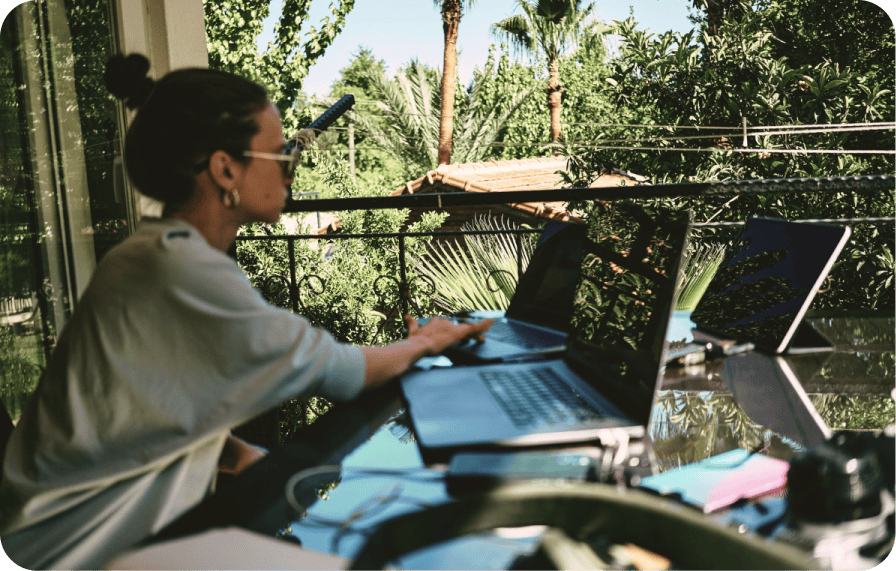
Who would have thought that one day, the same laptop you used at your cubicle could become your passport to freedom? This is what being a digital nomad means.
It’s not just a buzzword for influencers on beaches. It’s not a vacation or an extended gap year. Being a digital nomad is a real, sustainable way of living. They have a location-independent lifestyle, using technology to work remotely as they travel. To work with their clients or employers from anywhere in the world, they rely on tools like laptops, headsets, WiFi, and productivity & communication apps.
This lifestyle appeals to freelancers, remote employees, creative professionals, entrepreneurs, and anyone driven by the values of freedom, flexibility and independence.
If you’re one of them, let’s help you take the first step. We’ll explore everything you need to know about being a digital nomad. We’ll talk about the perks and the pitfalls, the beauty and the burnout.

Why The Digital Nomad Lifestyle Is Growing
The concept of a digital nomad first appeared in the 1997 book The Digital Nomad by Tsugio Makimoto and David Manners. In it, the authors predicted the rise of a powerful communication device that would one day enable people to work from anywhere — an idea that closely resembles how many people work today.
Yes, it’s not just a recent trend. Now, it has become a mainstream movement that has changed how and where people work. Here’s a closer look at why more individuals are choosing to trade fixed addresses for flexibility and freedom.
Cultural and Economic Shifts
Normalisation of Remote Work Post-COVID
Before 2020, the remote work lifestyle was a perk offered by progressive companies. However, when COVID-19 happened, many workers had to quickly adapt to remote work as offices shut down.

“The number of digital nomads has grown exponentially in the past few years, reaching at least 40 million people worldwide. During the Covid-19 pandemic, between 2019 and 2022, the number almost tripled. While remote work for many companies had to be provisional during the pandemic, it remained popular even after countries lifted travel restrictions, allowing international movement to resume for both leisure and business.”

Claudia Gualdi
Travel Intelligence Data Team Lead at Riskline
Now, it has become the norm. Businesses saw firsthand that work didn’t collapse without cubicles. Tools like Zoom, Slack, Notion and Asana made collaboration seamless across time zones. As trust in remote productivity grew, so did the opportunities for employees and freelancers to design their own work-life balance.
Costs of Living Crises in Large Cities
One of the biggest reasons people are leaving traditional work setups behind is simple: they can’t afford to live in major cities anymore. For instance, Amsterdam has become increasingly unaffordable for many residents.
According to Expatistan, Amsterdam ranks as the 6th most expensive city in Europe. When compared to other major cities in Europe like Paris, the cost of living in Amsterdam is notably higher, as Numbeo reports.
Overall, the cost of living in Amsterdam is approximately 12.5% higher than in Paris. This difference is largely driven by housing expenses. Rent prices in Amsterdam are a staggering 33.5% higher than in Paris.

It’s not just housing. IamExpat reports that grocery prices in the Netherlands are expected to rise this 2025. The CEOs of supermarket chains Plus and Jumbo shared that well-known A-brand products will likely become more expensive than private label (store brand) items, according to RTL Nieuws.
This is because manufacturers are asking for higher purchase prices. Some producers even want to raise prices by as much as 20% due to rising costs of raw materials, like milk.
Although Dutch salaries are competitive by European standards, the rising cost of living erodes purchasing power. The gap between income and quality of life is especially frustrating for younger generations, who find themselves working hard but still unable to afford independent housing or long-term financial security.
Growing Desire For Lifestyle Freedom and Cultural Experiences
More than ever, people aren’t just working to survive. The traditional promise of success tied to a static office job, a city apartment, and a two-week vacation each year is no longer enough.
For a growing number of workers, especially millennials and Gen Z, the ultimate goal is not stability, but freedom: to travel, to experience different cultures, to live life on their own terms.
For younger workers, quality of life now outweighs career prestige. In a 2023 Deloitte survey, although nearly half of Gen Z (49%) and over half of millennials (62%) see work as a key part of their identity, they’re now placing more value on having a balanced life.

For both groups, having a healthy work-life balance is not only what they admire most in others but also a key factor when deciding where to work.
Remote and hybrid setups are also important to these younger workers. Around three out of four who are currently working from home or on a hybrid schedule say they’d think about quitting if they were forced back to the office full-time.
What’s more, a survey revealed that for 76% of Gen Z and Millennial Americans, the new American Dream is being able to live and work wherever they choose.
Their reasons include a desire for a more intentional lifestyle, lower living costs, the ability to travel anywhere, and the freedom to prioritise experiences over material things.
Technology and Infrastructure Enabling the Shift
Wi-Fi Accessibility, Cloud Tools, Zoom/Teams/Google Meet
Today’s workers are no longer tethered to an office because the very architecture of work has changed. Workspaces now live in the cloud.
Access to fast, stable internet is now widely available in cities, small towns, and even developing regions. According to Statista, global average download speeds were similar for mobile and fixed broadband by March 2025. Mobile reached around 91 Mbps, while fixed broadband was about 98 Mbps.
Some countries, however, are far ahead of the global average. Singapore topped the charts with an average fixed broadband speed of 345.33 Mbps, closely followed by the United Arab Emirates and Hong Kong.

These ultra-fast connections make it easier for digital nomads to collaborate in real time, host video calls without interruptions, and upload or download large files with ease.
What’s more, over 94% of enterprises use cloud services in some capacity. The rise of Software as a Service (SaaS) tools further supports the digital nomad lifestyle. Platforms such as:
-
Notion (for knowledge management and project tracking)
-
Slack and Discord (for team communication)
-
Trello, ClickUp and Asana (for workflow management)
-
Figma (for design collaboration)
…have made it easy for distributed teams to function without any loss of productivity. Many of these tools offer offline functionality and mobile apps for flexibility even in places with intermittent connectivity.
Add this with the fact that virtual meetings are no longer a novelty. In 2020, Zoom went from 10 million daily users to over 300 million in just six months. Up until this very day, Zoom, Microsoft Teams and Google Meet continue to dominate the remote work ecosystem.
Thanks to features like live transcription, screen sharing, and integration with calendars and task apps, digital nomads can participate in high-level meetings from a beach café in Greece. All without skipping a beat.
Rise of Coworking and Coliving
Another key enabler of the nomadic lifestyle is the rise of purpose-built coliving and coworking spaces. Companies like The Citylifer offer high-quality coliving buildings and residences designed for digital nomads.
One of their signature units, The Nomad Studio, features smart layouts like retractable beds and rotating furniture, maximising space without sacrificing comfort. Remote workers on the move benefit from these setups by having everything they need in one place: a workspace, a home, and a built-in community.
Shared areas like lounges, rooftop gardens, and coworking lounges create opportunities to meet others, while private units offer solitude when needed. It’s flexible, affordable, and perfect for a mobile lifestyle.
Moreover, Market Research Future reports that in 2024, the global coworking market was valued at $22 billion and is projected to hit $25 billion by 2025. Experts expect it to grow to $82 billion by 2034, with an annual growth rate of 14.1%.

Rising Number of ‘Digital Nomad’ Visas
Many countries have launched digital nomad visas to recognise the economic value of remote workers. These programs often include tax incentives, low paperwork requirements, and permission to bring family members.
Some examples include:
-
Estonia: First country to launch a digital nomad visa in 2020.
-
Portugal: Offers a D7 passive income visa and a digital nomad visa with minimal income requirements (around €2,800/month).
-
Barbados: Welcome Stamp allows stays of up to 12 months.
-
Costa Rica: Requires proof of monthly income of at least $3,000 (individual) or $4,000 (family).
As of writing, more than 50 countries provide digital nomad visas or special permits for remote workers.
Benefits of Being a Digital Nomad
Do you know why more people are choosing a life without borders?
Let’s explore the benefits of being a digital nomad through real-life examples of people who’ve embraced this lifestyle and found freedom, flexibility and fulfilment along the way:
Freedom of Location
The freedom to work from virtually anywhere is arguably the most defining benefit of the digital nomad lifestyle.
“On a personal level, I like being able to work from where I want and when I want. I like to be able to travel and still work from there if I want to.”
David McNeill
Founder of Expat Empire
Being location-independent lets digital nomads live and work on their own terms. Many find they’re not just more productive, they’re also more present — for family, for rest, for themselves. The lifestyle lets them create space for emotional well-being, meaningful moments, and a pace that actually feels human.
Some chase good weather, moving from place to place to enjoy sunshine year-round. Others pick countries with a lower cost of living, like Vietnam or Portugal, so their money goes further compared to places like San Francisco or Sydney.
This lifestyle also means they get to mix things up — one month in a quiet mountain town, the next in a buzzing city.
It’s all about finding what works best for them while keeping things fresh and inspiring.

Cultural Immersion and Personal Growth
Living abroad isn’t the same as travelling through. Digital nomads often stay long enough to pick up local languages, participate in festivals, learn new customs, and develop a nuanced understanding of different ways of life.
Being away from home challenges your comfort zone. You learn to navigate new bureaucracies, grocery stores, even social cues. You’ll eat food you never imagined trying and figure out how to ask for directions, order coffee, or just say thank you.
In the process, you start to see yourself differently. Without the familiar routines and expectations, you begin to notice what really matters to you.
You grow more patient, more adaptable. Maybe even a little braver.
“We want to expand our minds, both personally and professionally, by learning and experiencing things that are different from what we’re used to.”

Gabriela Bedinelli
Digital Nomad
Work-Life Balance and Autonomy
Unlike the rigid 9-to-5, digital nomads have the autonomy to design their own routine.
Forget about standing on a packed platform, waiting for a train that’s five minutes late. No more explaining to your boss why traffic made you late. No more setting your alarm two hours earlier just to beat the morning rush.
“When I used to work in the city, I would often spend my mornings sitting in traffic on the way to work. What’s usually a 10-minute journey on a quiet Sunday morning, would often become a 40-minute journey in rush hour. I’m a big podcast fan so these journeys were a great way of burning through them, but I can certainly think of better ways to spend my time than sat in traffic.”

Ryan Scollon
Google Ads PPC Consultant
Now, you decide when to start your day. You can work from a beachside café, a quiet forest cabin, or wherever feels right that week.
Want to take a long lunch? Go for it. Need a midday break for a walk or a nap? That’s your call. You build a life that works around your energy, focus, and joy.
Flexible Housing Options
Without a mortgage or lease tying them down, digital nomads can follow the seasons and opportunities.
In fact, many are turning to short-stay coliving for its convenience, flexibility, and built-in community. These spaces come fully furnished with all-inclusive rates that cover rent, Wi-Fi, utilities, and even cleaning.
Unlike traditional rentals, there are no long-term leases or hefty deposits, and most allow stays from just a week to a few months. Coliving also offers shared spaces like kitchens and lounges, helping nomads quickly form connections with others.

Challenges Digital Nomads Face
Life as a digital nomad often looks like a dream on Instagram. Coding sessions on sun-drenched beaches, café-hopping while you close a deal, answering emails in a hammock, filming content with a mountain view in the background.
But behind the Instagrammable pictures lies a set of challenges that can wear even the most adventurous traveller thin.
Let’s peel back the curtain and explore some of the common challenges digital nomads face:
Visa and Legal Complexities
Understanding the legalities of long-term travel and remote work is one of the most stressful aspects of nomad life. Unlike tourists, digital nomads often find themselves in grey zones: neither full residents nor traditional tourists.
Take Belize, for example. Their visa requires a high income compared to other digital nomad visas. You need to earn at least $75,000/year on your own, or $100,000 if you’re bringing your family.
For many digital nomads, especially freelancers or self-employed people, this amount can be hard to earn.
What’s even harder to get is Norway’s digital nomad visa. Officially known as the Self-Employment visa, applicants must be self-employed and have a signed contract with a Norwegian client in place before applying. The contract must guarantee an annual income that meets or exceeds the national minimum wage, currently set at €35,719.
Other legal complexities include local labour laws, taxes, healthcare access, and residency rights.
Make sure you do your research. Violating these laws can result in hefty fines, blacklisting, or in extreme cases, deportation.

Juggling Time Zones
While it’s thrilling to say you’re working from Bali while your client is in New York, juggling multiple time zones can quickly become overwhelming.
That 3pm Zoom call might be 3am where you are. And if you’re managing multiple clients or working with a global team, keeping track of everyone’s availability becomes a daily mental workout.
Studies show that for every hour of time difference between team members, real-time communication drops by about 11%.
That means if you’re 6 hours ahead of your coworkers, you’re likely missing out on a good chunk of live conversations or spontaneous brainstorming.
On the flip side, teams working in the same or similar time zones report up to a 19% boost in communication throughout the day.
It’s simply easier to collaborate, solve problems, and get things done when everyone is online at the same time.
Loneliness and Lack of Community
It’s easy to assume being a digital nomad is never lonely. You’re constantly meeting new people, exploring cities, swapping stories in hostels.
The truth is, many digital nomads live in a state of constant transition. Friendships are fleeting. They’re formed over a weekend hike or a shared dorm room, then left behind as you both head off in different directions. You say hello just as often as you say goodbye. After a while, all the surface-level conversations start to blur.
Even in countries where digital nomads usually gather, connection isn’t always easy. People are busy and often focused on their own hustle. And if you’re an introvert or new to the lifestyle, breaking into those social circles can feel intimidating.
But you don’t have to stay lonely! Many nomads eventually find ways to create their own kind of stability: returning to favourite cities or joining intentional communities. Some start passion projects that anchor them. Others build online spaces where they can show up fully.

Lack of Structure and Routine
Being free from the office is never a bad thing. But what traditional work gave us, without us even realising, was structure. There was a rhythm to it. The boundaries between work and rest, weekdays and weekends, morning and evening — they all had their place. You knew when your day started and when it ended.
As a digital nomad, those boundaries dissolve. Days bleed into each other. Time zones blur. You might work late into the night to sync with clients in a different hemisphere, or take meetings before sunrise. Meals happen whenever you remember to eat. You might forget what day it is entirely. Was it Wednesday or Sunday? Does it matter when in the next hour you’ll be on a plane again?
And without the grounding presence of familiar people or routines, small things start to feel heavy. Your workouts vanish. Your sleep schedule crumbles. You suddenly miss your mom’s cooking.
There’s no ‘home’ clock to return to. No built-in end-of-day. Just you, your laptop and the next hotel.
Where Digital Nomads Live: Comparing Housing Options
Now that we’ve explored the highs and lows of being a digital nomad, it’s time to talk about something more grounded: where digital nomads actually live.

Hotels and Hostels
Digital nomads start off in hotels or hostels when arriving in a new city. They are available everywhere, easy to book and perfect for short-term stays while scouting for more permanent lodging.
However, hotels are now adapting to meet the growing demands of digital nomads. Take the Public Hotel in New York, where the lobby has become an unofficial coworking hub. Throughout the day, you’ll find freelancers and professionals plugged in at communal tables, soft lounge seating, or tucked away in corners — laptop open, coffee in hand. With fast Wi-Fi and a stylish, welcoming atmosphere, it’s a far cry from the sterile business centers of traditional hotels.
But not all hotels are like this. While some high-end or boutique properties are reimagining their spaces for remote workers, many traditional hotels still fall short when it comes to the needs of digital nomads.
Poor Wi-Fi connections, lack of proper desks or workspaces, limited access to communal areas and rigid check-in/check-out times can all make hotel stays frustrating for those trying to work on the go.

Airbnb and Short-Stay Rentals
Once digital nomads have had time to settle in and understand the local area, many transition from hotels to Airbnb or other short-stay rentals. These options have the comforts of a home — you get a kitchen, laundry facilities, and dedicated living and work areas.
Nomads can live more like locals. This is especially appealing for those who value cultural immersion and a more grounded lifestyle. Having a local address also makes it easier to access services like gym memberships, local SIM cards, and banking services.
However, nightly or weekly rates are usually higher than traditional rents. Some cities see inflated rates due to high tourist demand or limited rental supply.
Some listings may also lack ergonomic furniture, reliable internet, or quiet surroundings.

Traditional Rentals
Some nomads look into traditional apartment leases to save money and feel more rooted in one place. They come with long-term lease agreements, lower monthly rates, and fewer service fees.
You won’t have to worry about cleaning fees and inflated “tourist pricing” often built into short-stay platforms. On paper, it seems like a smart way to live more like a local.
But in practice, it can be surprisingly hard to access this market — especially as a foreigner. Local residents know which neighbourhoods are safe, which landlords are reputable, and which listings are worth your time. For someone new to the country, it’s easy to feel lost.
Many rental agreements aren’t listed online or are posted on platforms in the local language. Even when you do find an available unit, there’s the issue of unfamiliar rental laws, translating contracts, and spotting red flags. This includes inflated deposits, fake listings, or scams targeting newcomers who aren’t yet street-smart.
Landlords also typically expect a six to twelve month lease commitment — far from ideal for someone constantly on the move. Upfront costs like security deposits, agency fees, and utility setups can strain your budget. Many rentals come unfurnished, which means investing in furniture and appliances you’ll soon leave behind.

Coliving Spaces
Coliving spaces are rapidly emerging as the most balanced and digital nomad–friendly housing option. These are fully furnished, all-inclusive living environments specifically designed with remote workers in mind. Think of them as a hybrid between a home, a coworking space and a built-in community.
Some of the benefits of coliving for digital nomads include:
- Fully furnished rooms – Move in with just your suitcase
- Flexible lease terms – Weekly or monthly stays tailored for transient workers
- Reliable WiFi and workspaces – Most coliving spaces prioritise strong internet and coworking areas
- Built-in community – Connect with fellow nomads, creatives and entrepreneurs
No need to fret about the usual headaches of moving into a new city. There’s no need to worry about negotiating with landlords or buying furniture. You can get straight to your routine: working, exploring, meeting new people.
Where Digital Nomads Are Going: Top Cities in 2025
In 2025, digital nomads are seeking stability, quality of life, community, and the infrastructure to support a great work-life balance. While classic hubs like Bali and Lisbon remain popular, a new crop of cities is rising in the ranks.
Lisbon, Portugal
Lisbon is now one of Europe’s go-to spots for freelancers and digital nomads. The city offers a mild climate all year round, stunning architecture and hotels, delicious cuisine, and a cost of living that’s lower than major capitals like Amsterdam and London.

Bangkok, Thailand
Bangkok continues to be a favorite among digital nomads in Southeast Asia. With its low cost of living, world-class street food, and fast internet, the Thai capital offers everything a remote worker needs. Coworking spaces like Launchpad and The Work Loft provide reliable infrastructure, while its Long-Term Resident (LTR) Visa offers up to ten years of residency, access to healthcare, and more.

Barcelona, Spain
Barcelona ranks among the top digital nomad destinations; not just in Spain, but across all of Europe. It’s known for its thriving coworking culture, which is a major perk for remote workers. The city is home to a wide range of coworking spaces that suit different preferences, working styles, and budgets. You get high-speed internet, meeting rooms, comfortable lounges, and even wellness areas.
What’s even better? Some coliving spaces double as coworking hubs. Take Node Living, for example. We stayed there a few months ago and genuinely loved the experience.

Why the Netherlands is Gaining Ground
Though often overlooked in favour of flashier Mediterranean or Southeast Asian locales, the Netherlands is quietly becoming a magnet for digital nomads. Cities like Amsterdam, Rotterdam, and Utrecht are becoming underrated gems. Here’s why:
English-Friendly and International
Studies show that around 90% to 93% of people in the Netherlands can speak English well enough to hold a full conversation. The Dutch are among the most fluent non-native English speakers in the world. In major cities, nearly everyone — from baristas to bureaucrats — speaks excellent English. This makes it incredibly easy for newcomers to integrate, handle paperwork, and get involved in the local community without feeling lost in translation.

Central Location in Europe
Because of its central location in Europe, the Netherlands makes it easy to travel to nearby countries like Germany, Belgium, France, and the UK. If you’re staying in cities like Amsterdam or Rotterdam, weekend trips across the border are simple to plan and enjoy.
Strong Digital Infrastructure
The Netherlands boasts top-tier infrastructure for remote workers, including lightning-fast Wi-Fi, excellent coworking spaces, and flexible, all-inclusive coliving spaces.
Urban Yet Bikeable and Laid-Back
Unlike bigger European capitals, Dutch cities combine urban density with a calm, bikeable environment. Amsterdam is famously cycle-friendly, with canals and green spaces around every corner. Rotterdam brings a more modern, architectural feel with plenty of coworking options and cultural spots. Utrecht, with its historic charm and youthful population, offers a quieter alternative that’s still plugged into the nomad lifestyle.

Quality of Life
Stable, safe and clean. Public transport is efficient, healthcare is top-tier, and there’s a strong social safety net. For digital nomads tired of chaotic or unstable environments, Dutch cities offer peace of mind and a place to truly settle in.
How to Start Your Digital Nomad Journey
The work from anywhere lifestyle is more achievable than ever, but it takes thoughtful planning to get it right. Here’s how to kickstart your journey, one step at a time.
Reflect on Your Work Setup
Before you start packing your bags, take a hard look at your current job or business. Can it be done remotely?
- If you’re employed, speak with your manager about the possibility of working from home. This can be permanent or even on a trial basis. More companies are open to remote arrangements than ever before, especially if you can prove it won’t affect your productivity.
- If you’re self-employed or freelancing, consider whether your client work can be managed online. Many roles in writing, design, marketing, customer support, software development, and consulting translate well to remote work.
- If you’re just starting out, research freelance platforms, remote job boards, or start building a skillset that aligns with the remote work lifestyle (e.g. web design, SEO, content writing, or virtual assistance).
Remember, the foundation of a sustainable digital nomad lifestyle is having a reliable income stream you can access from anywhere.

Choose Your First Base
It’s tempting to book multiple flights and try to live the dream everywhere at once. But becoming a digital nomad doesn’t mean bouncing between time zones every week. Well, at least not in the beginning.
Start with one destination. Choose one city where you can test the waters for a month or two. Look for places that are:

-
Digital nomad–friendly: Good internet, coworking spaces and community events are key.
-
Affordable: Cost of living varies widely. Lisbon, Budapest and Chiang Mai are popular partly because your money goes further.
-
Internationally connected: Cities with decent airport access, in case you need to fly back home or visit clients.
-
Safe and welcoming: English-friendly, culturally rich cities like Lisbon, Berlin and Rotterdam are ideal starting points with thriving nomad communities.
Pick somewhere that gives you a soft landing and enough infrastructure to focus on your work and lifestyle.
Set Up Your Remote Work Essentials
Once your destination is set, make sure your remote office is just as mobile as you are. Investing in the right gear and tools can make all the difference.
-
Reliable laptop: Lightweight but powerful enough to handle your workload.
-
Noise-cancelling headphones: Important for calls and working in noisy cafés or hostels.
-
VPN: Keeps your data secure on public WiFi and gives you access to geo-restricted content.
-
Cloud storage: Services like Google Drive or Dropbox let you back up your files automatically and access them from any device.
-
Time zone tools: Use apps like World Time Buddy or Google Calendar’s time zone feature to stay in sync with clients or colleagues across the globe.
-
Project management tools: Trello, Notion, Asana, or ClickUp help keep your tasks in check and communication clear.
-
WiFi backup: A local SIM card with data or a portable hotspot ensures you’re never stranded without the internet.
Finally, make sure your software and systems are tested before leaving. Run a mock workday entirely from your laptop at a coffee shop or library to simulate the digital nomad experience. If it’s smooth sailing there, you’re more likely to have fewer issues abroad.

Plan Where You’ll Stay
Accommodation can make or break your early digital nomad experience. The right space sets the tone for your work-life balance, productivity, and even your mental health. Fortunately, there are more options than ever designed for remote workers.
-
Short-term rentals: Sites like Airbnb and Booking.com offer furnished stays that are easy to book for a few weeks or months.
-
Local listings: In many cities, you can find rentals directly through Facebook groups or local platforms, which may offer better deals for longer stays.
-
Coliving spaces: These are designed specifically for digital nomads. Think fully furnished rooms, coworking areas, community dinners, events, and flexible lease terms. Places like The Citylifer offer plug-and-play lifestyles perfect for beginners.
-
Hostels and shared flats: These can be budget-friendly and offer built-in social opportunities. However, they may not be ideal for long work sessions unless they have designated coworking areas.
Where you stay should support your work and lifestyle, not stress you out. Prioritise stability and quiet in your first few weeks, then branch out once you find your rhythm.
The Future of the Digital Nomad Lifestyle
In 2015, entrepreneur Pieter Levels delivered a compelling presentation predicting that by 2035, there would be one billion digital nomads worldwide.
world has shifted in ways few could have imagined. High-speed internet has become global, cloud-based tools have untethered workers from physical offices. The pandemic also started a global rethinking of where and how we work.
Today, we’re seeing that prediction inch closer to reality. Here’s how the lifestyle is evolving:
A More Normalised Work-from-Anywhere Culture
We’re seeing a rise in remote-first and hybrid workplace models—where being in an office is optional or limited to a few days a week. In fact, Archie reports that approximately 64% of company leaders say their organisations have adopted a hybrid work setup.
In the US alone, nearly 22.8% of employees work remotely at least part-time as of March 2025, which translates to roughly 36.07 million workers.
Moreover, a 2023 study reveals that 93% of organisations have either already implemented or are planning to implement a digital-first business strategy.
When most companies are building with a ‘digital-first’ mindset, it opens up more flexibility for employees to work from anywhere—not just from home.

Diverse Nomad Archetypes Are Emerging
Gone are the days when digital nomadism was seen as the domain of single 20-something freelancers hopping between hostels. A new wave of nomads is reshaping the scene.
Some prefer staying longer in one place. They are ‘slowmads’ who take their time to settle in, focus on work and really experience the local culture. Others are remote-working families who travel with their kids, thanks to online schooling and more family-friendly housing options abroad. There are also part-time nomads who spend only part of the year living overseas, using their home country as a base.
This growing variety shows that being a digital nomad can look different for everyone.
The idea that you need to be constantly travelling with nothing but a backpack and a laptop is outdated.
You can shape it around what matters most to you — your work, your relationships, your health or your long-term goals.
Why the Netherlands Could Be The Next Big Hub
There’s a stereotype that digital nomads are always chasing adventures and living on the edge. Lonely, broke and figuring things out in cramped hostels. While that version still exists (and has its charm), the digital nomad lifestyle has evolved far beyond it.
Digital nomads seek stability, infrastructure and creative energy without sacrificing quality of life.
This is why we can expect more digital nomads in the Netherlands. Here’s why:
- Excellent transport links: With its central location in Europe, the Netherlands offers fast, affordable access to Germany, France, Belgium and the UK. Weekend getaways are a train ride away, and Schiphol Airport keeps you globally connected.
- World-class digital infrastructure: Consistently ranking high in internet speed, reliability and tech innovation, the Netherlands is made for remote work.
- International and inclusive: Over 90% of Dutch people speak English fluently, and many cities—especially Amsterdam, Rotterdam and Utrecht—cater to international residents with ease. You’ll find coworking spaces, expat communities and a welcoming social atmosphere.
- The City of Rotterdam: If you want the perks of a global city without the tourist overload of Amsterdam, Rotterdam is a compelling alternative. It’s known for its modern architecture, innovative spirit, diverse population and thriving creative industries. The city is laid-back but vibrant, with art collectives, food halls and waterfront coworking spaces. It offers everything a digital nomad needs, without the crowds or inflated prices.

Why Rotterdam Is the City to Watch
Known for its modern architecture, innovative spirit, diverse population and thriving creative industries, it offers everything a digital nomad could ask for. But without the chaos or price tag of more obvious destinations.
Rebuilt from the ground up after WWII, Rotterdam didn’t cling to tradition. It innovated. Today, it’s a city of striking contrasts: sleek skyscrapers alongside gritty street art, historic harbors turned into creative hubs, and a cosmopolitan energy that’s refreshingly down-to-earth.
Here’s what makes Rotterdam stand out:
- Wellness-friendly, bike-friendly, work-friendly: With lush green spaces, riverside walking paths and an incredible biking network, Rotterdam makes it easy to stay active and inspired. And with lightning-fast internet and excellent infrastructure, it’s built for remote work.
- Global but grounded: Rotterdam is one of the most diverse cities in the Netherlands, with over 170 nationalities. English is widely spoken, and you’ll find global cuisine on every corner.
- A thriving creative and tech ecosystem: Rotterdam is buzzing with creative professionals, startups, designers and freelancers. In fact, according to Rotterdam Innovation City, the city has more than 1,600 startups and 21 accelerators that go beyond workspace and capital to truly support early-stage growth.

Final thoughts
So, what is a digital nomad, really?
At its core, it’s someone who blends work and travel by leveraging technology to work from anywhere in the world. But more than that, it’s a response to how life and work are changing.
Maybe you’ve been offered the chance to work remotely. Maybe you’re craving more flexibility, or feeling stuck in routines that no longer suit your lifestyle. Maybe you’re curious about what it’s like to live in another country. Not just visit, but live. These are the moments when the digital nomad lifestyle can become possible and incredibly appealing.
We’re seeing a growing number of people, especially in their late 20s to early 40s, take this leap. Some are freelancers or entrepreneurs. Others are full-time employees with laptops and Wi-Fi. What unites them isn’t a love of travel for travel’s sake, but a desire for more agency: over their schedule, their environment, their pace of life.
And here’s the thing: you don’t have to be constantly on the move. Being a digital nomad isn’t about ticking off countries or living out of a suitcase. It’s about choosing where, how, and why you live and work. It can mean staying in one place for months, building routines, finding community, and still having the freedom to move when the time feels right.
The world is only becoming more remote-friendly, more globally connected and more accepting of location-independent careers. So if any part of this lifestyle speaks to you, now might be exactly the right time to explore what it could look like for you.

FAQ
Do I need to travel constantly to be a digital nomad?
No, you don’t need to travel constantly to be a digital nomad. While some digital nomads embrace a perpetual travel lifestyle, many others prefer to stay in one location for several months or even a year before moving on.
Do I need a special visa to be a digital nomad?
It depends on the country. Some offer specific digital nomad visas (like Portugal or Bali), while others may allow remote work on a tourist visa for a short time. Always check local visa regulations before you go.
Can I be a digital nomad with a full-time job?
Absolutely! Many digital nomads work full-time for companies that offer remote work options. The key is that your job must be location-independent. As long as your employer allows you to work from anywhere with an internet connection, you can be a digital nomad with a full-time job.
What kind of work do digital nomads usually do?
Common jobs include software development, graphic design, content writing, marketing, teaching English online, customer support and consulting. Basically, any job you can do online could work.
Is coliving safe for solo nomads?
Generally, yes. Most coliving spaces are designed for remote workers and come with security, Wi-Fi and a built-in community. Just read reviews, check amenities and make sure it suits your preferences.
How do I meet people while working remotely?
Coworking spaces, coliving setups, meetup events or local Facebook groups are great ways to meet fellow nomads and locals. Socialising might take effort at first, but it’s definitely doable.
Is it expensive to live as a digital nomad?
It depends on where you go and how you live. Cities in Southeast Asia, Eastern Europe and Latin America are popular for being affordable. You can live modestly or luxuriously depending on your budget and preference.
Can couples or families be digital nomads too?
Absolutely. Many couples and families travel while working remotely. It takes more planning, especially for kids’ schooling or healthcare, but it’s entirely possible and becoming more common.
How do I choose the right city as a digital nomad?
Look for cities with strong internet, affordable living costs, safety, visa availability and a good remote work community. Consider time zones and lifestyle, too. Test one place for a month before committing longer!